


"Therefore we ought to give the more earnest heed to the things which we have heard, lest at any time we should let them slip. For if the word spoken by angels was stedfast, and every transgression and disobedience received a just recompence of reward; How shall we escape, if we neglect so great salvation; which at the first began to be spoken by the Lord, and was confirmed unto us by them that heard him" Hebrews 2:1-3 (KJV)
LIBRARY BOOKS: HISTORY of the Church (Ecclesiastical History)
|
The Hail & Fire Books Library is a FREE online Christian resource for Christian books, Puritan, Reformed and Protestant exhortative works, Catholic and Protestant polemical and apologetical works, bibles, histories, martyrologies, and works on |
eschatology; in real text, PDF, and scanned image formats. By using the Hail & Fire Library you agree to the following. By using the Hail & Fire Library you agree to the following copyright notice. |
|


VISUAL AUDIO BOOK (YOUTUBE) | FREE TEXT (FULL VIEW) | ADDED DEC. 29, 2023
The Virgin Queen:
The Marriage Speech of Queen Elizabeth I
Given to the House of Commons, February 1559
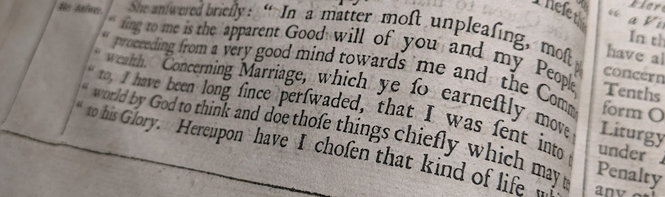
Answer to the House of Commons' Petition for the New Queen of England to Marry. The text of the speech is excerpted from "History of the Most Renowned and Victorious Princess Elizabeth, Late Queen of England" by William Camden (c. 1688).
Introduction:
During the 45 year reign of Elizabeth I, Queen of England and Ireland from 1558 to 1603, she became known as “the Virgin Queen,” who never married, nor took even an intimate lover, in spite of her many royal and noble suitors, the pressures from her private counselors, and the British Houses of Parliament.
Elizabeth I was born September 7th 1533, to King Henry VIII and his second wife, the Protestant Queen Anne Boleyn, during a period in history when the Roman Catholic Church exercised immense power in the world, claiming an absolute spiritual and temporal authority over all peoples, kingdoms and kings. Henry VIII had famously split with the Roman Pontiff in his divorce from the Catholic Queen Catherine of Aragon, and an intense religious conflict was ongoing in Europe and England as the Roman Church sought to eradicate the Protestant Bible Christians, who were promoting the reading of the Holy Bible, and struggling for the private use of their own consciences towards God. Two things which were then outlawed by the Roman Catholic authorities, and which generally cost the lives of those who dared to deviate from the infallible teachings of Roman Catholicism.
Being third in the royal line of succession, and herself a devout Protestant Christian, the Princess Elizabeth was unlikely to inherit the English throne. However, neither her younger Protestant half-brother, King Edward VI, who first inherited the throne in 1547 upon the death of Henry VIII, nor her elder Roman Catholic half-sister, Queen Mary I, who inherited the throne only 6 years later, in 1553, enjoyed lengthy reigns.
When Mary died, just 5 years after Edward, in November of 1558, Elizabeth I succeeded to the throne of England. Her ascension brought immediate relief to the persecuted Bible Christians, who had suffered greatly during Queen Mary's reign, and it ignited the powerful animosity of the Pope in Rome, and his devoted proponents throughout Europe. Queen Elizabeth was then only 25 years old, but she well understood the importance of her high office, and among other things, what might be at stake in her own marriage, for the English nation, and for the Christian Church at large.
Elizabeth was officially coronated in January of 1559, and in early February, the House of Commons petitioned their new Queen to marry, and provide an heir for the English throne. They received her prompt and decisive reply just several days later.
Marriage Speech of Queen Elizabeth I, Feb. 1559:
"In a matter most unpleasing, most pleasing to me, is the apparent goodwill of you and my people, as proceeding from a very good mind towards me and the Commonwealth. Concerning Marriage, which ye so earnestly move me to, I have been long since persuaded, that I was sent into this world by God to think and do those things chiefly, which may tend to His glory. Hereupon have I chosen that kind of life which is most free from the troublesome cares of this world, that I might attend the service of God alone. From which, if either the tendred [middle english: tender] marriages of most potent princes, or the danger of death intended against me, could have removed me, I had long agone enjoyed the honour of an husband. And these things have I thought upon when I was a private person. But now that the public care of governing the Kingdom is laid upon me, to draw upon me also the cares of marriage, may seem a point of inconsiderate folly. Yea, to satisfy you, I have already joined myself in marriage to an husband, namely, the Kingdom of England. And behold, which I marvel ye have forgotten, the pledge of this my wedlock and marriage with my Kingdom."
To which Queen Elizabeth took off the royal ring from her finger, showing that ring to them, with which she had solemnly given herself in marriage, to her Kingdom, with a set form of words at her coronation. After this pause, she then continued:
"And do not upbraid me with miserable lack of children; for every one of you, and as many as are Englishmen, are children and kinsmen to me; of whom, if God deprive me not, (which God forbid,) I cannot without injury be accounted barren. But I commend you that ye have not appointed me an husband, for that were most unworthy the majesty of an Absolute Princess, and unbeseeming your wisdom, which are subjects born. Nevertheless, if it please God that I enter into another course of life, I promise you I will do nothing which may be prejudicial to the Commonwealth, but will take such a husband, as near as may be, as will have as great a care of the Commonwealth as myself. But if I continue in this kind of life I have begun, I doubt not but God will so direct mine own and your counsels, that ye shall not need to doubt of a Successor which may be more beneficial to the Commonwealth than he which may be born of me, considering that the issue of the best princes many times degenerate. And to me it shall be a full satisfaction, both for the memorial of my name, and for my glory also, if when i shall let my last breath, it be engraven upon my marble tomb, here lieth Elizabeth, which reigned a virgin, and died a virgin."
Listen on YouTube (Visual Audio Book): Elizabeth I: Marriage Speech